Space Data Centers: How Will AI Servers Be Cooled in Orbit? Artificial intelligence is driving an unprecedented increase in computing demand. As data centers grow larger and more energy-intensive, the industry is exploring new ways to provide electricity, manage heat and reduce the environmental impact of computing infrastructure. One of the more ambitious ideas is to move some data center operations into space.
Companies such as Google and SpaceX have explored concepts involving orbital computing infrastructure, while companies working on space-based computing systems are investigating how high-performance processors could operate beyond Earth’s atmosphere. But moving servers into orbit creates a fundamental engineering challenge: How do you cool a data center when there is no air around it?
On Earth, data centers reject heat through air-conditioning systems, cooling towers, liquid cooling circuits and heat exchangers. In space, conventional air-cooled systems cannot work in the same way. Heat must ultimately be transferred to the external environment through thermal radiation.
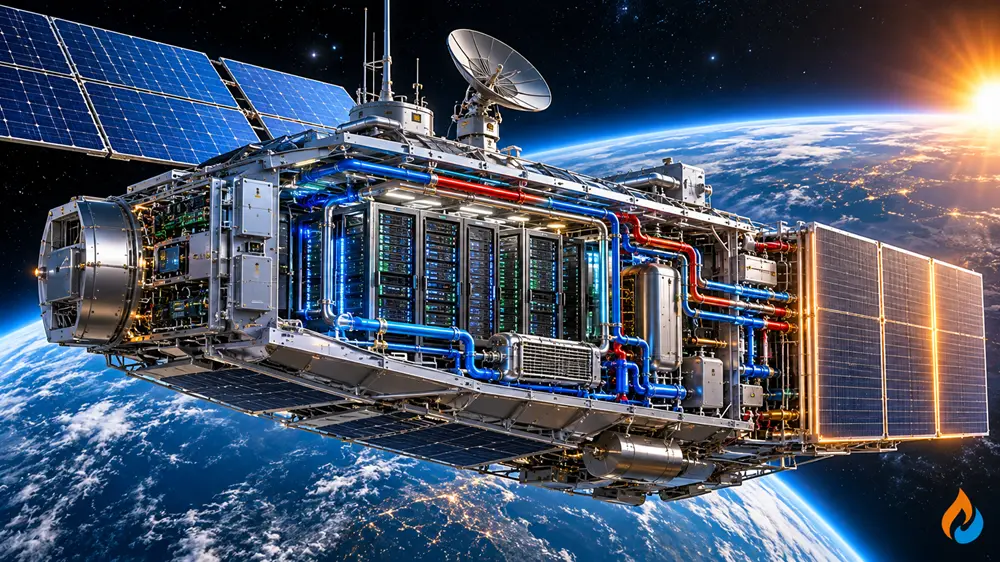
This changes the entire cooling-system design. Liquid cooling, heat pipes, pumped fluid loops and large radiator panels become essential components of the thermal management architecture.
Why Are Data Centers Being Considered for Space?
The idea of placing data centers in orbit is based on several potential advantages. Solar energy is available in space without atmospheric attenuation, and certain orbital configurations can provide relatively predictable solar exposure. Space-based infrastructure could also reduce the need for land and some terrestrial cooling resources.
However, these advantages should not be confused with a proven economic case. Launch costs, radiation protection, maintenance, communications, equipment lifetime and heat rejection remain major challenges.
The concept is particularly relevant to artificial intelligence workloads because modern AI processors consume substantial electrical power and generate large quantities of heat. A conventional data center can use water, air and mechanical refrigeration systems to remove this heat. An orbital data center must use a different approach: heat can be transported internally by fluids, but it must eventually be rejected into space through radiators.
The Biggest Challenge: Cooling in a Vacuum
On Earth, heat is transferred through three fundamental mechanisms:
- Conduction: Heat transfer through direct contact between materials.
- Convection: Heat transfer between a surface and a moving fluid, such as air or water.
- Radiation: Heat transfer through electromagnetic waves.
In a vacuum, there is no surrounding air to provide conventional external convective cooling. A radiator cannot simply release heat into an airflow because there is no atmosphere around it.
This does not mean that convection disappears everywhere inside the spacecraft. Fans and liquid circulation systems can still move air or coolant within sealed compartments. However, the final transfer of heat from the spacecraft to the external environment must rely primarily on thermal radiation.
The cooling process therefore has two distinct stages:
- Heat is collected from processors and other electronic components and transported through a thermal management system.
- The collected heat is transferred to radiator surfaces, which emit infrared radiation into space.
This distinction is central to the design of an orbital data center.
Direct-to-Chip Liquid Cooling for Space-Based Servers
High-performance AI processors generate concentrated heat loads. Removing this heat directly from the processor is more effective than relying exclusively on air moving through a server enclosure. Direct-to-chip liquid cooling is therefore a strong candidate for orbital computing systems.
In this arrangement, cold plates are installed directly on processors, GPUs or other high-power components. A coolant circulates through channels inside the cold plates and absorbs heat from the electronic components. The heated coolant then flows to a heat exchanger or thermal distribution unit, where its energy is transferred to another cooling circuit or directly to the spacecraft’s radiator loop.
A simplified system consists of:
- AI processors and GPU modules
- Cold plates
- Coolant distribution manifolds
- Pumps
- Filters and control valves
- Heat exchangers
- Temperature, pressure and flow sensors
- Radiator panels
The main advantage is that heat is captured close to its source. This reduces the amount of heat that must be removed from the server enclosure through air and can improve temperature control.
However, liquid cooling in space introduces additional design requirements. Pumps must operate reliably under the relevant acceleration and microgravity conditions. Fluid connections must withstand launch loads and long-term operation, while leaks must be detected and isolated quickly.
Material compatibility is also critical. Coolants, seals, pipes, coatings and heat exchanger materials must be selected to prevent corrosion, degradation and contamination over the intended service life.
Heat Pipes and Loop Heat Pipes
Pumped liquid circuits are not the only way to transport heat inside a spacecraft. Heat pipes and loop heat pipes are established thermal control technologies used in spacecraft and satellites.
A conventional heat pipe is a sealed component containing a working fluid. Heat entering the evaporator section causes the fluid to evaporate. The vapor travels toward a cooler section, where it condenses and releases its latent heat. The liquid then returns to the evaporator, commonly through a capillary wick structure.
The cycle allows heat to be transported efficiently without requiring a conventional mechanical pump. Loop heat pipes operate on a related principle but use a separate liquid return line and vapor transport line. Their architecture can support longer transport distances and more flexible equipment layouts.
For a space data center, these technologies could be used to:
- Transfer heat away from electronic equipment
- Connect server modules to thermal distribution systems
- Reduce dependence on continuously operating mechanical pumps
- Transport heat to radiator assemblies
Heat pipes do not eliminate the need for radiators. They only transport heat from one location to another. The heat must still be rejected to space.
Pumped Fluid Loops and Thermal Distribution
A large orbital data center would likely require a more extensive thermal distribution network than a small satellite. Pumped fluid loops can collect heat from multiple server racks or processor modules and transport it to centralized heat exchangers or radiator circuits.
A simplified arrangement may include two separate loops:
- Primary cooling loop: Coolant circulates through cold plates and collects heat from the processors.
- Secondary thermal loop: A separate fluid circuit receives heat through a heat exchanger and transports it to the radiator panels.
Separating the loops can help isolate sensitive electronics cooling circuits from the external thermal rejection system. It can also make maintenance, fluid selection and system control more flexible. The final architecture would depend on the heat load, operating temperatures, equipment layout, redundancy requirements and radiator configuration.
In a system with multiple server modules, the thermal management network would also need to handle changing loads. AI workloads do not necessarily operate at constant power. Processor utilization can rise and fall rapidly, creating transient thermal conditions. The cooling system must therefore be designed not only for average heat load but also for peak load, control response and fault conditions.
Radiators: The Most Critical Part of Space Cooling
A radiator is the component that ultimately rejects waste heat into space. On Earth, a cooling tower can transfer heat to the atmosphere through evaporation and convection. A spacecraft cannot use the surrounding vacuum in this way. Instead, radiator surfaces emit thermal radiation. Their ability to reject heat depends mainly on:
- Radiator surface temperature
- Surface emissivity
- Effective radiating area
- Orientation and view to space
- Solar radiation exposure
- Infrared radiation received from Earth
- Radiation reflected by Earth (albedo)
- Thermal interaction with nearby spacecraft surfaces
A radiator facing deep space can potentially reject heat more effectively than one exposed to strong solar radiation or significant infrared radiation from Earth. The radiator surface is also important. High-emissivity coatings can improve thermal emission, while low solar absorptivity can reduce unwanted solar heat absorption.
In practice, radiator design is not simply a matter of selecting a surface area. The spacecraft’s orbit, attitude, surrounding structures, thermal environment and operating temperature all influence the final design. Deployable radiator panels may be considered when a large radiating area is required but launch volume and mass are limited.
How Much Radiator Area Is Required for a 1 MW Data Center?
The Stefan–Boltzmann law provides a useful first approximation of the thermal radiation emitted by an idealized radiator surface.
The net radiative heat transfer can be expressed as: Q = ε × σ × A × (Tr⁴ − Tspace⁴)
Where:
- Q = net radiated heat transfer (W)
- ε = radiator surface emissivity
- σ = Stefan–Boltzmann constant (5.67 × 10⁻⁸ W/m²K⁴)
- A = effective radiating area (m²)
- Tr = radiator absolute temperature (K)
- Tspace = effective surrounding temperature (K)
For an initial engineering estimate, consider a data center with a total heat load of 1 MW.
Assume:
- Heat load: 1,000,000 W
- Radiator temperature: 60°C (333.15 K)
- Surface emissivity: 0.90
- Effective background temperature: 3 K
The required idealized radiator area can be estimated by rearranging the equation: A = Q / [ε × σ × (Tr⁴ − Tspace⁴)]
Using the assumptions above: A ≈ 1,590 m²
This result shows the scale of the heat rejection challenge. Even under idealized conditions, rejecting 1 MW of heat requires a very large radiating surface. The radiator temperature has a major influence on the required area. Increasing the operating temperature increases radiative heat rejection and can reduce the required surface area.
The following table illustrates this relationship for the same 1 MW heat load and an emissivity of 0.90.
| Radiator temperature | Approx. heat rejection per m² | Idealized radiator area |
|---|---|---|
| 40°C | 491 W/m² | 2,038 m² |
| 60°C | 629 W/m² | 1,591 m² |
| 80°C | 794 W/m² | 1,260 m² |
These values are theoretical estimates, not final spacecraft design figures. The calculation assumes that the radiator radiates to a very cold background and that its entire effective surface is available for heat rejection. It does not account for solar absorption, Earth infrared radiation, albedo, radiator orientation, view factors, shading, thermal losses, piping and manifold temperatures, or practical design margins.
A real orbital system would require a detailed thermal analysis using its actual orbit, attitude, radiator geometry and operating conditions. The effective radiator area may therefore be considerably larger than the idealized result.
Thermal Control: More Than Just Removing Heat
A space data center must maintain its equipment within acceptable temperature limits under changing environmental conditions. The external thermal environment can vary significantly depending on the spacecraft’s orbit and orientation. A radiator may receive direct solar radiation, reflected sunlight from Earth or infrared radiation emitted by the planet.
During different parts of an orbit, the spacecraft may also move between sunlight and Earth’s shadow. These transitions can produce changing thermal loads. Thermal control systems must therefore manage both heat rejection and heat retention.
Typical thermal control components and methods include:
- Multi-layer insulation (MLI)
- Electrical heaters
- Temperature sensors
- Thermostats and control electronics
- Variable-flow coolant circuits
- Heat pipes and loop heat pipes
- Radiator orientation and thermal isolation
- Thermal control coatings
Multi-layer insulation reduces unwanted heat transfer between spacecraft surfaces and the external environment. Electrical heaters may be required to prevent sensitive components or fluid circuits from becoming too cold.
The system must maintain a suitable temperature range rather than simply trying to make every component as cold as possible.
Can Phase Change Materials Be Used in Space Data Centers?
Phase Change Materials (PCMs) can absorb or release significant amounts of thermal energy while changing phase, usually from solid to liquid or vice versa. In an orbital data center, PCM-based thermal storage could potentially help manage short-term changes in processor heat generation.
For example, if server power temporarily increases, a thermal storage unit could absorb part of the additional heat. The stored energy could then be released gradually to the cooling circuit when the load decreases. This approach may reduce short-term temperature fluctuations and help the thermal management system respond to transient loads.
However, PCM is not a permanent heat rejection solution. It can store thermal energy temporarily, but the accumulated heat must eventually be transferred to the radiator and emitted into space. The mass, volume, thermal conductivity, containment design and long-term stability of the PCM would all need to be considered.
The Main Engineering Challenges
Moving a data center into orbit does not eliminate the engineering problems associated with terrestrial facilities. It introduces additional constraints.
1. Radiator mass and deployment
Large radiator areas may require extensive structures, support mechanisms and deployment systems. These components increase launch mass and introduce mechanical complexity.
2. Radiation exposure
Electronic components in orbit are exposed to energetic particles and radiation. AI processors, memory modules, power electronics and control systems may require shielding or radiation-tolerant design strategies.
3. Maintenance and repair
A terrestrial data center can replace a failed pump, server or heat exchanger. Repairing equipment in orbit is much more difficult and expensive. Long service life, redundancy and fault isolation are therefore essential.
4. Microgravity and fluid management
Fluid systems must be designed for operation in microgravity. Conventional assumptions about liquid settling, air separation and gravity-driven drainage cannot simply be applied.
5. Power generation and distribution
AI processors require substantial electrical power. Solar arrays, power conditioning equipment, energy storage and electrical distribution systems must all be sized for the intended computing load.
6. Launch and replacement costs
Servers and thermal control equipment must survive launch loads and operate reliably after deployment. The cost of launching, replacing and upgrading hardware is a major part of the overall economic assessment.
7. Data transmission
A space-based data center must communicate with users and terrestrial networks. Communication capacity, latency, ground station coverage and data transfer costs all influence its practical value.
Will Space Data Centers Become a Reality?
Space-based data centers are an ambitious concept, but the idea is not simply about placing conventional servers inside a satellite. It requires the integration of several engineering disciplines: thermal management, electronics, spacecraft structures, power generation, radiation protection, fluid mechanics and communication systems.
Cooling is one of the most important challenges because every watt of electrical power consumed by computing equipment ultimately becomes heat that must be managed.
Liquid cooling can collect heat from processors. Heat pipes and pumped fluid loops can transport it through the spacecraft. But only radiator surfaces can reject that heat into the vacuum of space. The scale of the required radiator area also demonstrates why thermal management cannot be treated as a secondary design issue. For high-power AI computing systems, it is a fundamental part of the spacecraft architecture.
Space data centers may eventually become useful for specific computing tasks, particularly where orbital infrastructure offers a clear operational advantage. However, their commercial viability will depend on much more than processor performance. Launch economics, power generation, thermal rejection, maintenance and communications must all work together.
The central engineering question is not just how to run AI servers in space. It is how to continuously remove megawatts of heat from a computing system when there is no atmosphere to cool it.
Kaynaklar
- NASA – Small Spacecraft Systems Virtual Institute: Thermal Control — Heat pipes, fluid cycles, openable parts, surface properties, and thermal control.
- NASA – Small Spacecraft Systems Virtual Institute: Thermal Control — Stefan-Boltzmann yasası, ışınım, soğurma ve görüş faktörleri.
- Google – Project Suncatcher — Testing TPU, heat pipes, and radiators in space.
- Google – Project Suncatcher Prototype in Orbit — Prototype satellite mission scheduled for October 1, 2026.
- Google Research – Toward a Future Space-Based, Highly Scalable AI Infrastructure System — System architecture, power, communication, thermal management, and scalability for artificial intelligence infrastructure in space.
- U.S. GAO – Data Centers in Space — The maturity level of the technology, technical and economic barriers.
- IEEE Spectrum – Why Orbital Data Centers Are Harder Than Silicon Valley Thinks — GPU heat load, radiator area, surface degradation, and heat dissipation issues in space.