As artificial intelligence systems continue to evolve, not only computing power but also cooling requirements are rapidly increasing in data centers. High-density GPU servers are pushing the limits of conventional air cooling, while direct-to-chip liquid cooling systems are becoming central to data center design. As AI models continue to advance, data centers require significantly higher computing power. The GPUs providing this computing power, however, generate substantial amounts of heat during operation.
The critical point here is: More powerful GPU = higher electricity consumption = more heat = more powerful cooling system.
Therefore, in next-generation data centers built for AI, the cooling system is no longer merely an auxiliary mechanical installation system; it has become one of the main engineering components determining the capacity of the data center. The current ASHRAE AI Data Center Energy Performance Framework document also states that air cooling has reached its practical limits for high-density AI systems and that the direct-to-chip liquid cooling approach has become an industry standard for AI and HPC infrastructures.
Why Is So Much Heat Generated in AI Data Centers?
In a normal office computer, the heat generated by the processor and other components is relatively low. In data centers, however, the situation is completely different. Particularly in GPU clusters used for AI training, numerous high-performance processors operate simultaneously. A significant portion of the electrical energy ultimately turns into heat.
For example, as the electrical load of a rack in a data center increases, this load must be continuously removed by the cooling system. Therefore, data center design is no longer limited to asking:
“How many MW of electrical power will we provide?”
The following question has become equally important:
“How will we continuously remove the heat generated at this MW level?”
The current ASHRAE AI data center design approach also emphasizes that electrical and cooling systems should not be evaluated independently of one another.
Why Is Conventional Air Cooling Becoming Insufficient?
In traditional data centers, the heat generated by servers is primarily transported by air. CRAC or CRAH units, fans, cold-air distribution, and hot-aisle/cold-aisle configurations are the fundamental components of this system. However, an important physical problem arises here: the heat-carrying capacity of air is considerably lower than that of liquids.
As the amount of heat generated by a GPU or a high-density rack increases, higher airflow rates, larger air ducts, greater fan power, and more advanced air distribution are required to transport the same amount of heat. At a certain point, the problem goes beyond simply saying “let’s use a larger air handling unit.”
Because as rack density increases:
- airflow requirements increase,
- fan energy consumption rises,
- hot spots become more difficult to control,
- cold-air distribution becomes more complex,
- greater air movement is required within the data hall,
- the capacity of the existing CRAC/CRAH infrastructure may become insufficient.
The ASHRAE 2026 AI Data Center Framework states that air cooling has reached its practical limits in high-density AI applications and that liquid cooling has become the preferred approach for high-density racks.
What Advantage Does Liquid Cooling Provide Here?
This is where the subject becomes particularly relevant to mechanical and plumbing engineers. Liquid cooling transports the heat generated by the processor through a liquid rather than air. One of the most prominent methods is:
Direct-to-Chip Liquid Cooling
In this system, a cooling fluid is circulated through a dedicated cold plate installed directly on or very close to the processor. The heat generated by the processor is removed from the system as follows:
GPU → Cold Plate → Coolant → TCS → CDU → Facility Water System → Heat Rejection
This creates a mechanical installation architecture that is significantly different from the conventional air-handling approach. The objective is no longer simply to cool the air within a room.
We are talking about transferring the heat generated directly by the processor through a hydronic system.
Within ASHRAE’s current framework, direct-to-chip systems are considered a Technology Cooling System (TCS) together with cold plates, manifolds, pumps, valves, piping, sensors, CDUs, and heat rejection systems.
So, Is Water Actually Being Introduced into the Data Center?
There is an important distinction here. When it is said that an “AI data center is cooled with liquid,” it should not be assumed that the entire system consists of a single water loop. Next-generation systems generally include multiple circuits and equipment that separates these circuits from one another. A simplified system can be considered as follows:
Chiller / Dry Cooler / Heat Rejection
↓ Facility Water Loop
↓ CDU
↓ Technology Cooling System (TCS)
↓ Rack Manifold
↓ Cold Plate
↓ GPU
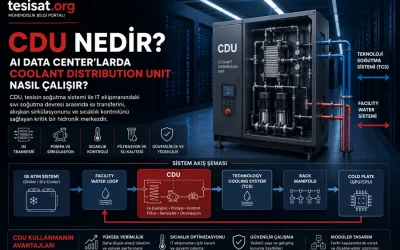
In this architecture, the CDU serves as a critical interface between the facility-side cooling system and the IT-side liquid cooling circuit. A CDU may contain a heat exchanger, pumps, filtration, control components, temperature and flow measurements, and various other components. ASHRAE also defines CDUs as critical equipment providing heat transfer, pumping, and temperature control between the IT cooling circuit and the facility water system.
We will examine the CDU topic separately in our second article.

How Is Heat Transferred More Efficiently with Liquid Cooling?
The fundamental engineering advantage here is heat transfer capacity. While very large airflow rates may be required to transport the same amount of heat with air, a liquid can transport large amounts of heat through a much more compact system. This provides a significant advantage for liquid cooling in high-density GPU racks.
ASHRAE’s 2026 framework particularly emphasizes the ability of direct-to-chip liquid cooling to support high-density racks and capture heat more effectively compared with conventional air cooling. The document recommends liquid or liquid-assisted cooling architectures for rack densities of 50–100 kW and above.
Moreover, these figures are expected to increase further in the future. ASHRAE’s current assessment states that AI rack densities are increasing rapidly and that even megawatt-scale racks are among the future design scenarios.
Why Does Rack Density Matter in AI Data Center Cooling?
In fact, the fundamental reason behind the liquid cooling trend is not simply the word “AI.” The real issue is:
Power density.
As the heat load of a rack increases, it becomes increasingly difficult to remove the same amount of heat from the surrounding environment using air. For example, there can be a significant difference between the rack densities encountered in traditional data center designs and those of next-generation AI racks. ASHRAE’s AI data center framework states that some AI racks can exceed 100 kW/rack. Meanwhile, older infrastructures having been designed for much lower densities creates a significant retrofit challenge.
Therefore, when designing a new AI data center, not only the current rack load but also the load that future GPU systems will generate must be taken into consideration. As a result, mechanical installation design now asks not only: “How many kW is this rack today?” but also: “How many kW/rack can this infrastructure support several years from now?”
Will Air Cooling Completely Disappear?
No. One of the biggest misconceptions in this area is the assumption that liquid cooling will completely replace all air cooling systems in data centers. In reality, hybrid cooling architectures are the more likely scenario.
For example:
- GPUs → direct-to-chip liquid cooling
- CPUs → liquid cooling or air cooling
- Network equipment → air cooling
- Storage systems → air cooling
- Power supplies → air cooling
- Other electronic equipment → air cooling
Mixed systems can be implemented in this manner.
ASHRAE’s retrofit approach also recommends that instead of completely removing the existing CRAC/CRAH infrastructure, high-heat-generating GPUs should be converted to direct-to-chip liquid cooling while the remaining loads are handled by the existing air cooling system. This approach is particularly important when converting existing data centers to AI infrastructure.
Why Is Liquid Cooling Directly Relevant to Mechanical Installation Engineering?
Because the system is no longer simply a “cooling unit.” There is a genuine hydronic system involved. During the design process, the following factors must be evaluated together:
- flow rate,
- pressure drop,
- pump selection,
- pipe diameters,
- valve selection,
- filtration,
- water quality,
- temperature control,
- ΔT,
- redundancy,
- leak detection,
- heat exchanger capacity,
- automation,
- BMS/DCIM integration,
- heat rejection,
- maintenance and commissioning
In other words, the AI data center is becoming a new field of work not only for the IT industry but also for mechanical installation engineering. Within ASHRAE’s current TCS approach, pumps, valves, piping, heat rejection systems, temperature-pressure-flow sensors, and leak detection systems are directly considered part of the cooling architecture.
Does Liquid Cooling Always Consume Less Energy?
This point also requires careful consideration. It would not be correct to say that “using liquid cooling automatically reduces energy consumption.” The entire system must be evaluated. Pump energy, chiller operation, dry coolers, cooling towers, fans, heat exchangers, and control strategies must all be considered together.
For example, in a warm-water cooling approach, it may be possible to reduce the need for chillers by using higher water temperatures and achieve greater free cooling through systems such as dry coolers. ASHRAE states that warm-water cooling can contribute to chiller-less designs and lower water consumption. However, it also points out that this is not automatically the best solution for every project. Therefore, the correct question is not:
“Does liquid cooling save energy?”
but rather:
“Which liquid cooling architecture, combined with which rack density and heat rejection system, provides the lowest total energy consumption?”
This distinction is highly important from an engineering perspective.
Water Consumption Is Also Becoming a New Challenge
As AI data centers expand, not only electricity consumption but also water usage is becoming an important consideration. Water consumption is a significant design criterion, particularly in systems using evaporative cooling and cooling towers. Therefore, in next-generation data centers, alternatives such as:
- dry coolers,
- waterside economizers,
- warm-water cooling,
- closed-loop liquid cooling,
- heat recovery
are becoming increasingly important.
In recent years, pressure on data centers regarding energy and water consumption has increased. For example, Australian data center operator NextDC reported a deterioration in its water usage effectiveness metric in its 2026 report, providing a current example of the impact of AI and capacity expansion on cooling resources. Therefore, in future data center design, not only PUE – Power Usage Effectiveness but also indicators such as WUE – Water Usage Effectiveness are becoming increasingly important.
Why Has Cooling Become a Strategic Issue in AI Data Centers?
Because building an AI data center no longer simply means installing more GPUs. For GPUs to operate, the entire:
Electricity → Power Distribution → GPU → Heat → Cooling → Heat Rejection
chain must operate together. Insufficient capacity at any point in this chain can limit the actual capacity of the data center. Therefore, as AI data center investments grow worldwide, demand for cooling equipment is also increasing significantly. In a Reuters report dated September 1, 2026, strong demand driven by AI data center investments, particularly for power and cooling infrastructure, was highlighted, while liquid cooling systems were also described as becoming increasingly important.
An even more notable development is the investment being made by energy and cooling equipment manufacturers in the AI data center market. For example, on August 31, 2026, SLB announced that it would acquire data center cooling equipment manufacturer Kelvion in a deal valued at approximately $4.1 billion. This development demonstrates that data center cooling is no longer merely an HVAC subcategory but has become a major industrial market.
Conclusion: Cooling May Be the Hidden Side of the AI Revolution
When people think of artificial intelligence, they generally think of GPUs, processors, algorithms, and large language models. However, behind all these systems lies a much more physical problem: How will the heat generated by this computing power be removed? This is precisely why liquid cooling is becoming increasingly important in AI data centers.
With direct-to-chip systems, heat is captured directly at the GPU level, transported through the TCS, and transferred to the facility-side cooling system through equipment such as the CDU. As a result, AI is not only changing computer technology in data center engineering.
It is also reshaping electrical systems, mechanical installations, hydronic design, automation, and heat rejection systems. Perhaps in the coming years, one of the most critical questions determining the capacity of a data center will not be:
“How many GPUs can we install?”
but:
“How reliably and efficiently can we remove the heat generated by these GPUs?”
And at this point, the CDU – Coolant Distribution Unit emerges as a critical piece of equipment. In our next article:
What Is a CDU? How Does a Coolant Distribution Unit Work in AI Data Centers?
We will examine how the CDU operates between the facility water system and the IT-side liquid cooling circuit, from an engineering perspective, including pump, heat exchanger, filtration, control, redundancy, flow rate, and temperature management.