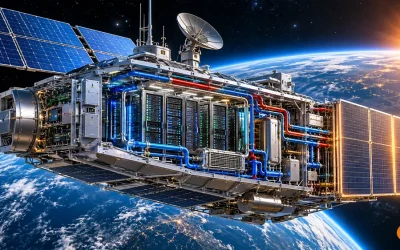
Nuclear energy is no longer associated solely with massive power plants. Microreactors are being developed as a new generation of nuclear reactors that can be manufactured in a factory and transported to the site, providing megawatt-scale electricity and heat.
When we think of a nuclear power plant, we usually picture enormous concrete structures, cooling towers, and construction processes that take years. But what if the entire nuclear reactor could be manufactured in a factory and transported to the site by truck? This is no longer just science fiction.
New generation microreactor designs developed in the US aim to produce nuclear energy on a much smaller scale. One such design, Westinghouse’s eVinci, is being developed to generate approximately 5 MWe of electricity, be fully assembled in a factory, and transported to the site by truck, rail, or other means.
Moreover, the system has a very important difference from classic nuclear power plants: it doesn’t have to use large amounts of water to cool the reactor.
What is a microreactor?
A microreactor is a type of nuclear reactor that is small in size and designed to be manufactured in a factory. In the general definition used by the DOE, microreactors are typically considered compact reactors that can provide power in the order of 1–50 MW of electricity. This scale is very small compared to a classic nuclear power plant. However, even 5 MW is not a power to be underestimated.
5 MW of continuous electricity generation is approximately equivalent to operating 5,000 1 kW electrical loads simultaneously. The aim here is not to meet the electricity needs of large cities with a single microreactor. But providing continuous power for a remote mine, a critical facility, a small settlement, a military facility, an industrial plant, or a large data center is a very different problem.

How can a nuclear reactor be made so small?
The most important change here is not just the reduction in the size of the reactor. It’s also the reduction of the massive auxiliary systems around the reactor. In traditional light water reactors, the heat from the core is transferred through pressurized water and numerous pumps, valves, heat exchangers, and auxiliary systems.
In microreactors, however, different cooling concepts can be used. eVinci is a striking example of this. In this design, hundreds of heat pipes are used to remove heat from the core.
What does a heat pipe do in a nuclear reactor?
We can roughly think of a heat pipe as a passive heat transfer device. The fluid working inside evaporates in the hot region, transferring heat; it condenses in the cooler region, releasing heat, and returns to the hot region. Thus, heat can be transferred without a large, continuously running pump.
This is extremely important in a nuclear reactor because: Reactor → pump → pipe → valve → heat exchanger
Instead of a long and complex cooling chain like this, the heat from the core can be transferred through numerous passive heat pipes. This not only reduces the size of the system but also changes the safety approach of the design by reducing the number of moving parts and high-pressure cooling systems.
Can a nuclear reactor operate without water?
Yes. This is one of the most interesting aspects of microreactors. In heat pipe designs like eVinci, the heat taken from the reactor core can be transferred through heat pipes instead of a classic primary cooling cycle that circulates water. Therefore, a large cooling water infrastructure is not required for the system to operate.
This is particularly important for remote areas where water is scarce or where establishing large cooling infrastructure is difficult. At the same time, the heat produced by the system can also be used solely for electricity generation. Different usage scenarios are possible, such as electricity + process heat + district heating.
So what is the fuel inside the reactor? TRISO
Some of the new generation microreactors use TRISO fuel. TRISO has a different structure than classic fuel pellets. The fuel material is prepared in very small particles, and each fuel particle is surrounded by multiple protective ceramic and carbon layers. This structure aims to increase the fuel particle’s resistance to high temperatures and radiation environments.
The eVinci design plans to use approximately 19.75% enriched TRISO fuel. Considering the high-temperature resistant fuel together with the passive heat removal system, the reactor’s safety philosophy differs from traditional large water-cooled reactors.
The most striking point: The reactor can be manufactured in a factory
A classic nuclear power plant is largely built on site. The goal of the microreactor approach, however, is: Manufacture in a factory → assemble → test → transport → install on site.
This could be a serious paradigm shift in nuclear energy. Because standardized manufacturing in a factory allows for the production of a large number of the same design, instead of repeating the same large-scale construction process at every site.
The NRC, in its new microreactor licensing approach, specifically considers models such as manufacturing license, standard design approval, and standardized licensing applicable to multiple sites. In other words, not only the reactor but also the manufacturing and installation model is changing in nuclear technology.
Can it really be transported by truck?
Yes, but it’s important to understand the phrase “transportable by truck” correctly. This doesn’t mean it can be attached to a regular truck and transported like ordinary cargo within the city. Transporting a reactor containing nuclear fuel; It is subject to very serious requirements such as radiation safety, physical safety, transport container, route, permits, and emergency planning.
Under the IAEA, safety and regulatory issues regarding the transportation of microreactors by road, rail, sea, and air were also addressed in 2026. In the US, the NRC’s newly proposed regulation includes methods such as risk-based transport package certification for the transportation of fuel-fueled microreactors.
Therefore, while the idea is technically feasible, the “transport by truck” part is actually as much a nuclear regulatory and safety engineering problem as it is an engineering problem. So, does eVinci really work?
The year 2026 is important here. In critical experiments for Westinghouse’s eVinci design, a critical state was reached on September 3, 2026, and the core temperature reached 1,011 °C during the test. This doesn’t mean a commercial eVinci plant is already generating electricity on-site.
However, physically testing the design with critical experiments is a crucial step in the transition from computer modeling to real engineering validation. The target for the commercial version is approximately 5 MWe of electricity and 8 years or more of operation without fuel replenishment.
The main idea in safety: What happens when the system fails?
In modern nuclear reactors, safety isn’t simply left to the logic of “if something breaks, the operator intervenes.” In microreactors, passive safety is particularly important.
For example, in the eVinci design, the residual heat from the core is designed to be transferred to the atmosphere via heat pipes and passive heat removal mechanisms without the need for an active pump to operate. This is crucial because even if the nuclear reactor is shut down, residual heat (decay heat) continues to be generated for a period of time due to radioactive decay in the core.
Therefore: Stopping the reactor ≠ instantaneous cooling of the reactor
This is precisely one of the fundamental problems of nuclear safety engineering. Microreactor designs aim to remove this heat without electricity or operator intervention.
Where could such a nuclear reactor be used?
The real advantage of a microreactor might emerge not in large cities, but in places where electricity is difficult or expensive to bring.
For example:
- Remote mining operations
- Off-grid settlements
- Critical infrastructure
- Military facilities
- Big data centers
- Industrial processes
- Hydrogen production
- District heating
- Post-disaster energy infrastructure
Here, nuclear energy doesn’t have to replace solar and wind power. In fact, microreactors can be considered as a continuous power source for hybrid microgrids that work in conjunction with renewable energy and battery storage systems.
Will the future of nuclear power plants really fit in the back of a truck?
It’s too early to say for sure. The fact that a microreactor is physically portable doesn’t mean it’s becoming economically, licensed, and commercially widespread. Fuel supply, licensing, safety, waste management, physical security, transportation infrastructure, and cost are still important issues that need to be resolved.
However, a very important shift is taking place in nuclear technology: Previously, the question was mostly: “How can we make a nuclear power plant bigger?”
Now, some engineers are asking a different question:
“Can we make a nuclear power plant small enough to be manufactured in a factory, compact enough to be transported, and passive enough to operate with minimal infrastructure on site?”
Microreactors are one answer to this question. And if this technology proves successful on a commercial scale, nuclear energy could transform from a technology that only generates electricity from giant power plants into a modular energy infrastructure that is manufactured in a factory, transported, and deployed wherever needed.